Thursday, August 15, 2019

ATA Summer Conference - Calling Statement

I am currently attending the ATA Summer Conference - "Initiatives in Leadership" program in Banff, AB.

This is the view from the bed in my hotel room.


I know...it sure makes it tough to leave in the morning!

Our task is to develop a calling statement that I will implement this year. I feel like I'm cheating a little as my calling statement is centered around work that began last year but will continue this year.

As this post is only meant to be limited to about 700 words, I will outline the project for now. More in-depth details will be provided in a future post which I will link here when it's ready.

Background of The Project:
Edmonton Public School Division developed a Mathematics Intervention / Programming Instrument (MIPI) which is an assessment for Grades 2-10 that is implemented at the beginning of the school year. In my school division, many of the teachers have implemented or will implement the MIPI.

I have concerns about some aspects of the MIPI. First of all, there are issues with some of the questions not quite hitting the outcomes I think they were meant to hit. However, my main 2 concerns are that 1) the questions are low-complexity questions and 2) they are all multiple-choice and numerical response. I understand that the intent was to get some basic data for a starting point however I think it's important to dig deeper. Why did they get that question wrong? What are the misconceptions? So, we developed / are in the process of developing what we lovingly call (for now) the MIPI+. (Yes Edmonton Public knows...)

We created 5 questions for each grade from grades 2-10 that delve deeper into students' conceptual understanding and deliberately try to pull out misconceptions. The first question (which is identical for grades 2-10), for example, is "Make the following statement true:  8 + 4 = __ + 5. Convince me."  (This question was taken from a research study which I will link when I have more time...this is due tomorrow morning after all). The students will take about 5 minutes to answer this question. The teacher, using the rubric, will take about 5 minutes to sort all the responses. As a result, the teacher will have a deeper understanding of what their students truly understand about equality and what misconceptions they have. The electronic version of the rubric, will be hyperlinked to our math framework which will answer the questions:
  • Why is this a misconception?
  • How is this misconception developed?
  • What is the research around this misconception?
  • How do I deal with this misconception once students have it OR how do I prevent students from developing this misconception? ie. What are the simple classroom activities and conversations can we have to develop this understanding?
  • What are grade appropriate questions I can ask my "grade 5" student to continue this work?
So what does this mean for this year?
I am going to work on the continued development of these resources (teacher guide, rubrics, student exemplars, training tools, etc.) this year.

Although teachers are not required to use this tool, in PLC's, we will support teachers in
  • understanding the purpose and intent of the MIPI+
  • working through the administration, assessment and analyzing of the MIPI+ (Even if they aren't assessing their own students, they will have an opportunity to analyze results)
  • determining next steps in student learning
  • exploring best practices in assessment
I will know I have made a difference with this project when I see
  • teachers administering, assessing and analyzing the results to benefit student learning.
  • teachers creating and sharing new questions that can be added to our math framework to continue the work.
  • teachers talking and sharing best practices around assessment.
The one key measure of success will be that when students move into the next grade and the teacher administers the MIPI+, the misconceptions, that were previously demonstrated, will be gone.

I will need help from people outside of my "echo chamber". We've heard a lot of "this is great!" I'm hoping to hear those thoughtful questions that challenge me to think more deeply about my reasoning behind the decisions we make. This will help me make the tool meet the needs of the teachers better. 

For example, I was asked, "You said we should do this at the beginning of the school year. (ex. beginning of grade 5) Why not administer it at the end of the school year (end of grade 4) and pass the information right away on to the next (grade 5) teacher? This would give the grade 5 teacher time to plan."

In the beginning my response was that you want the data of the students you actually have in front of you. If you have new students, you'll have to re-administer it anyways. Then after I had time to reflect, I changed the recommended implementation process. Although implementing all 5 questions at the beginning of the school year is still one of the options we recommend, we now suggest that the first question (Equality) is done right away. Then, you can appropriately plan for the equality work you need to do. Then 3 or 4 weeks later, you can do the second question (which focuses on place value in grades 3+). Teachers would do place value work, if needed. Then, the fraction question (Grades 4+) would be done about a week or so before you start fractions...and so on. This way, the work that you do with equality will help build their understanding of place value...and fractions...and so on.

I still don't recommend doing it in June! Though we did do one field test of this so we will see how those same students do when they right it again in September. Maybe there is no difference. We'll see.

I will seek mentoring and coaching from...anyone who is willing! I've received one suggestion but I'm still looking for others! I am an executive member of the Math Council so of course I'll be accessing them for lots of support as well. 

My peer coach(es) will be...all of you! In a future blog post, I will share more specific details about the project so that you can provide that constructive feedback.

Oh, and did I say that we will be sharing ALL of these resources freely? You just have to ask...once I've shared and you've explored the resources in more detail! I will post more information about that in my next blog post.

This project was a big part of my work last year and I can't wait to keep working on and revising it through all your amazing constructive feedback!

Sandi

Saturday, March 30, 2019

Do we have time for this? Analog clocks

There's some controversy out there around analog clocks. I've seen articles claiming that schools are taking them down because students can't read them. This causes an uproar. Two different sides are shared.

Let's look at some of the arguments proposed from both sides.

  1. Students always have their phone which displays a digital clock. This is often true...but not always. Some students/adults don't have cell phones. Secondly, though you can set up your phone to display a digital clock, you can also display an analog clock. So we should tweak that statement to say: Many students have a phone that displays a digital clock.
  2. Reading analog clocks teaches students how to skip count. It certainly helps build that skill. Even better would be if teachers also focused on multiplication rather than adding.  That's one 5, two 5's, three 5's, etc. as that aligns better to the numerals on the clock. 
  3. Reading analog clocks teaches students about base 60. True, if a teacher has talked about that concept. It also teaches a student base 13...think about a 24 hour clock.
  4. It teaches them how to read airline tickets. They have to know how to read a 24 hour clock. This is the only one that I think fails as an argument. Neither a digital nor an analog clocks teaches that unless it has 13:00, 14:00, etc on it. I'm not saying they don't need to know how a 24 hour clock works nor understand how to convert between the two formats. The fact that it's analog doesn't, by nature, teach that.
Those are just a few of the arguments for and against teaching analog clocks. I know there are more out there. I don't know if this is the reason analog clocks are being removed. I know that many have to be replaced due to old age and failure. Maybe they are taking them down because students can't read them in that school. I don't know. I haven't had an opportunity to delve deeper into the stories and it doesn't influence me in any way. My goal for this post is not to convince you either way because I'm not convinced either way.  

The bottom line is that I will teach students how to read both digital and analog clocks. Why? Because it's in my curriculum. In Alberta, it is addressed specifically in Grade 4. I am required to teach it. What clock type students choose to put on their cell phones or buy as a watch is totally up to them. 

So, how do I teach it? The same way I teach everything....by starting slowly, with visuals. Teaching time is NOT a separate unit that you dedicate a week to in January. Start it right away in September but go slow...very slow.

At the very beginning of the year.
First, take a clock that you can remove the inside circle from - the one that the numbers are written on.
Remove the inside circle. You can either do the next step right on that circle OR you can use the circle to trace out a brand new circle and write just the numbers 1-12 on it. I would prefer to draw a new circle with just 1-12 on it so that it removes the other info that's not needed yet. Honestly, either way is fine, though.

Draw lines from the center to each of the numbers 1-12. You'll be cutting it into "pie" shapes. Shade each of the sections in different colors. Write "ish" by each number. You'll have to place it in a way that the "ish" is in the correct portion.

I apologize that my numbers are so light. I was just working with a digital image.

Now, if possible, remove the minute and second hand. Or, if you can't or don't want to, color the hour hand so it stands out.

You may even want to draw arrows to help for each number.

Do a mini lesson on how to read this clock. The clock above shows that it's 10ish. Go through a few times. What would 4ish look like?

Yes, it's not very specific After a while, you can say something like, "it's 2ish almost 3."

Do this for two weeks, three weeks, four weeks. However long it takes. Do not rush this. You have all year to teach them about reading a clock. Once students are comfortable, you can move on to the next activity. 

Activity 2:
Did you know that you can tell what time it is within about 5 minutes even without the minute hand? Want to see? Open the following google slide presentation. Do not put it in presentation mode. On the second slide, place the clocks in the correct time order. You'll notice that one is at the bottom. During the actually activity, this would be sorted normally with all the other ones. While you are doing it, feel free to consider it during or after you are done the rest. Further on in my blog post, I'll talk about how I address that one with students. Then, move to slide 3 and add the times.

Now that you've done that, I'll explain the process I use with students.

I hand out 9 images of clocks that only have the hour hand drawn and hour numbers listed on it. These are the same images as you saw on slide 2. These have been cut out as separate images so they can be individually moved around. 

In pairs, students work together to sort them into time order.

Once they are done, they meet with another pair and compare their answers, sharing their reasoning, and moving clocks around some more if they choose.

I open up my google slides version and display slide 2 (not in presentation mode). It shows all of the clocks at the top (and one at the bottom). One student will come up and move a clock into the grey box. Another student will come up and place a clock that should come before or after it. They explain how they know it goes there. We repeat for all until we finally get to the clock that I placed at the bottom of the screen. Where does this one go? One student will come up and place it. I ask, "who else placed it here?" "Who placed it in a different spot?" That student comes up and places it in a different spot. "Interesting. We have two different answers. Talk to your partner. Which do you agree with and why?" The discussion then becomes: where does 12:00 go? Both spots! 

Now, I had out the cut out times from page 3. Students use these to match up to their clocks. They compare to a different group. As a class, we discuss.

The final page in the handout is an activity students will complete individually. Use this as a formative assessment to inform your teaching practices.

Now, use these types of phrasing when you are talking about the time in class. Again, don't rush this. Don't worry about using precise times yet. You'll notice that none of the examples referred to 3:15.

Activity 3:
Moving on to minutes? Don't refer to minutes yet. Give students an image of a clock that has the hour numbers written on it and the tick marks for minutes.  Have them count the ticks around the clock. What patterns do they notice?

Do they notice that it's in groups of five? Re-count the circle. one two three four five. That's one group of five (notice it's at the 1). 12345. That's two groups of five.. (notice that it's at the 2). How many minutes is that? 10 minutes. Interesting. Does that's always work? Keep checking. 12345. That's 3 fives. 15 minutes. Students figure out the rest. Now you're connecting it to multiplication.

Spend time working with naming regular times.  3:15 (not quarter after).

Activity 4:
Have students draw a circle and break it into quarters. What do they notice about that and how it relates to a clock? (If they drew it so the lines could be imagined as going through 12 and 6, 9 and 3, they should be able to make connections to quarter after.)

Make sure to talk about 15 minutes out of 60 minutes. 15/60. etc.

Activity 6:
Adding seconds? Have students figure out how high they can count in a minute. Time it according to just the minute hand. (Use a clock that doesn't have a second hand if possible and a really obvious shift from minute to minute). They count in their head. Share responses. Some will have counted really fast. Some counted really slow. That's ok. Talk about how we've decided to set a specific counting speed to help us be consistent. (It's humans who decided that there are 60 seconds in a minute.) Show a clock with a second hand and the minute ticks. Have them recount. Share responses. They're probably more consistent now. Then, have them focus on the second hand as it passes each of the ticks. That should bring them a lot closer to accurate timing.  

Now that they've done this activity, give them their own clock with tick marks to look at. What relationships can they find between the second hand and minute hand and hour hand. They might say, hour hand is shorter in length, second hand is longer in length. The longer the hand, the faster it moves. 60 seconds in a minute. 60 minutes in an hour. 

You can even give a puzzler: If I count to 60 that's 1 minute. How would you figure out how many minutes it would take me to count to 180.  Interesting enough, some may argue that it will take more than 3 minutes. Why? It takes longer to say one hundred seventy nine than it takes to say "one". Don't discount those arguments because they are absolutely correct! 


I can not stress enough: Go slow. Build understanding. Don't move on until they UNDERSTAND what's going on. You have all year.

Instructions and Handout:

Question for Self-Reflection:
How do you help students understand the concept of time? Not just reading a clock, but actual understanding of what time is?


Friday, November 16, 2018

Ditch C.U.B.E.S. when solving word problems!

No I'm not referring to manipulatives when I say ditch the C.U.B.E.S. when solving word problems. Full Disclosure: In the past, I probably fell into the C.U.B.E.S. supporter bunch. I've learned a lot over the past few years and now focus on other ways of teaching students how to solve word problems.

First of all, some of you may be asking, "What is C.U.B.E.S.?" C.U.B.E.S. is an acronym that you may have seen posted in math classrooms throughout the years. It may take the form of a different acronym but they all get to the same basic idea: when solving a word problem use C.U.B.E.S.
  1. Circle all key numbers.
  2. Underline the question.
  3. Box any key words.
  4. Eliminate unnecessary information.
  5. Solve and check.
Rather than telling you why I no longer use this, let's just jump right in and try an example.  As you look at each stage (before skipping ahead to the next image), ask yourself "What's the answer?"

You see the following word problem that makes no sense to you...


so you faithfully follow the steps...

Step 1: Circle all key numbers

What's your gut instinct for the answer?


Step 2: Underline the question:
Do you feel pretty confident about that gut instinct?


Step 3: Underline the key words:
Still feeling pretty confident?


This is where most students stop when they don't know how to solve a word problem. What answer do you think comes to mind?

Let's look at the full question. Were you right?


What operation is used in this question?

Did you know that most students who aren't sure what to do when solving a word problem will take all of the numbers they see and just add them?

Do you have a math word wall? Have you taught students to identify key words? What have they learned "in total" means?

Let's try another example:


Let's start with that key word: "in total"


Circle all the numbers:
What do you think the answer is?

Are you trying not to add? But if it's not adding, then what is it?

Let's look at the question: 

Woah...did that 5 just get removed from the calculations?  Oops! How many students might get thrown off by that?

Let's look at the full question....


What operation is used in this question?  Were there any other "key words" that students might have identified? Would they have helped or hindered their understanding?


Let's look at another example:

Here are the numbers...


Here's the question...


What are you going to do with the information?


Again, let's look at the full question. Does identifying key words help here?


You know me...here comes another example.


Let's pull those numbers out.


What's the question?


What's the full set of information?


So, what's the commonality in these four questions? They all focus on the key word "in total" which is typically taught as "addition" but every question actually addresses a different operation and some have extraneous numbers.

Here's a word problem for you to try: "There are 125 sheep and 5 dogs in a flock. How old is the shepherd?"  I'll wait while you figure it out.

Did that seem like a silly question to you? Obviously, you can't figure it out. 

Robert Kaplinsky asks 32 students to respond to this question. How many do you think agree with you and how many do you think attempted to solve it? Once you've made your prediction, watch the video.


Were you surprised? Why did so few students make sense of this problem?  How do we help students dig deeper into the word problem rather than relying on following steps like C.U.B.E.S.?

Brian Bushart introduced me to Numberless Word Problems and I fell in love.

As always, let's begin with an example.

There are some mice on the field. Some more mice come.


  1. What do you notice?
  2. What do you know to be true?
  3. What do you think to be true?


Take some time to think about the three questions in relation to the two statements above.

I have used this example in many of my workshops and I'm always fascinated by the discourse that occurs. If the participants/students have never experienced a numberless word problem before, they might experience confusion - there are no numbers! They sometimes start by retelling me the information that's on the board. I have had to prompt them to think about what "numbers" are in the question. What words might imply numbers? They will focus on the word "some". What does some mean? This is where it gets interesting. In my experience, most will say "more than one" but some will disagree and state that it means at least three. Why three? If the writer meant two, then they would have said "couple". We often spend quite a bit of time talking about the differences between "couple", "some", and another examples they might bring up. It's really very interesting. I'll then ask the question, "If -some- means -more than one- what do we know?". Students will have time to talk about that. They'll naturally start to think about the question "How many mice are on the field now?". Invariably, I'll hear the answer 3 but then they'll discuss how more than 1 and more than 1 has to be more than 3. They'll share their reasoning.  I'll follow up this question with "if -some- means -more than two- what do we know?". After we have fully dissected this question, I will replace one word:

There are 7 mice on the field. Some more mice come.

  1. What do you notice?
  2. What do you know to be true?
  3. What do you think to be true?

We'll discuss what's changed and how that changes the rest of the information we talked about. After a full discussion, I adjust the question again.

There are 7 mice on the field. 4 more mice come.

  1. What do you notice?
  2. What do you know to be true?
  3. What do you think the question is going to be?
  4. Solve that question.
At this stage, students solve the question.

Questions like this are easy to create. Just pull out a question that you would give them anyways, replace the numbers with generic words like "some", "many", etc. Check out #numberlesswp on twitter. 

CAUTION! This is great at the beginning of a class. Do NOT spend an entire class talking about addition and then pull out this question. Why? If we do 40 minutes of addition questions and then we have a "word problem", students are just going to assume that it's addition. The thinking stops and they revert to running a procedure rather than delving into the meaning behind the words.

Can you run a numberless word problem in other formats? Absolutely! Brian gave me permission to turn his numberless graph into a presentation I can share with teachers. I've embedded it below. Click through it, thinking carefully about each slide, asking yourself the same 3 starting questions as in the mouse question above. I've inserted a blank slide between each image mainly so I didn't accidentally click too many times in a row when presenting. :) You can download the slideshow from my account and you definitely should check out Brian's "original blog post" on the activity. 


Once students have spent time making sense of a problem without numbers, when they get to a question they are not sure how to solve, they will slow down and think more deeply about the information provided. They won't just take the numbers, throw in an operation and "solve" the question.

Question for Reflection:
How do you think your students would do in the "How old is the shepherd" problem? Try it in your class and see how they do. Are you surprised by their responses?

Activity to Try:
There are many words / phrases like "in total" that have many mathematical meanings depending on the context of the problem. Can you create 4 word problems that each use that word/phrase but utilize a different operation (like my examples above)?

Thursday, November 8, 2018

The equals sign does not mean the answer comes next!

As part of the team who worked on developing Elementary Mathematics Professional Learning Opportunities (EMPL), I spent a significant amount of time learning about the importance of Equality and have presented many times across Alberta on this topic using the resources and research we compiled through the project. A recent comment on Facebook made me aware that I should write a blog post about this too! If you've visited the Equality portion of the EMPL site, you will see that this post is a compilation of a part of those resources. Note: All images that contain the EMPL logo are pulled from the presentation document that we developed.

Our team defined 3 big ideas around Equality. 
  1. Mathematically, equality refers to a relationship between objects that can be quantified.
  2. Mathematically, equality can refer to a relationship between units of measure.
  3. Operations emerge as a way to balance an inequality.
This post will focus on the first big idea: "Mathematically, equality refers to a relationship between objects that can be quantified."

I use the term "objects" loosely. In the beginning, students will be considering and using concrete objects (bears, counters, beans, etc.). As their understanding progresses, they will move on to more abstract representations of those same objects. Even in higher grades, when you are referring purely to a symbolic representation such as an algebraic expression, it still refers to objects of some kind.  You’ve abstracted the objects out of the equation. Please don't get hung up on the terminology or lack thereof that I have used here. Let's look at the bigger picture and then we can always return to the tendency, preference and need we have to define terminology more explicitly.  :)

Before we start, please jot down a simple addition or subtraction equation that you would ask students to solve in a K-4 classroom. We will come back to this question later.

Take a moment to think about the following: 
How would your students answer this question? "What does the equal sign mean?"

I would recommend going into your classroom and asking your students that question. Ask it in grade 2. Ask it in Grade 6. Ask it in high school. Just ask. I'll wait. Come back when you are ready...

Researchers asked students this very question. They looked at students' responses and determined that there were two kinds of understanding.

One is an "operational understanding". Students who have an operational understanding of the equals sign might respond by saying...

These students believe the equal sign means "add the numbers" or "the answer".

How might an "Operational" student respond when asked to complete the following statement to make it true?  
3 + 2 = __ + 1


Most operational thinking students will put a 5 here because 3 + 2 = 5.

Some will even continue and tell you the answer, therefore, is 6 because 5 + 1 = 6.

The other type of understanding is a "relational understanding". Students who have a relational understanding of the equals sign might respond by saying...

These students see the equal sign as an equivalence relation between two quantities.

How might a "Relational" student respond when asked to complete the following statement to make it true?
3 + 2 = __ + 1

Relational thinking students will write a 4 here because 3 + 2 = 5 and 4 + 1 = 5


Researchers asked students to do the following:
Make this statement true.
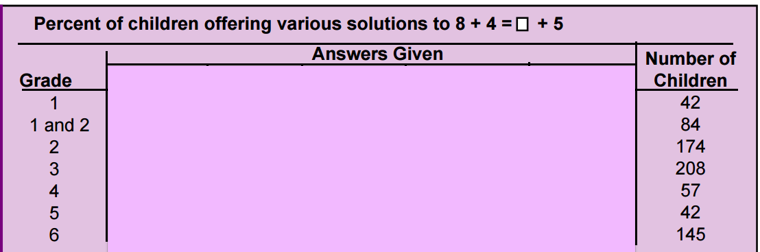
8 + 4 = __ + 5

What percent of your students do you believe would get this right? What other answers do you think you might get? Now, without pre-teaching anything or having a prior discussion, give this question to your students and see how they respond. Their answers will tell you a lot about their understanding of equality and the equals sign.

Let's take a look at the results.

How would "Operational" students respond? 
They may have answered 12. The numbers below indicate the percent of students who gave this response.


"Operational" students may have also responded with 17. How do you think they arrived at that answer?

Some even wrote both 12 (in the first blank) and then = 17 at the end.

What percent responded correctly with the answer 7? 
"Other" refers to any answer given that was not one of the four previously discussed.

If we choose to believe the results from the research study are still accurate today, about how many students in your class truly understand the equals sign? I strongly recommend that you give this question to your students to see how they respond.

So what do we do?

Let's look at Equality as a quantity through a few True or False questions. I've included images from the EMPL presentations, but you should use concrete objects for students to look at when doing this activity in your class. 


This one should be pretty easy for both you and your students. I would say something like, "The first set has a quantity of 3. The second set has a quantity of 3. They both of a quantity of 3. They are equal. Let's replace those quantities with their symbols. There are 3 objects on each side.
3 = 3

This is when it gets interesting for students. If they just see 3 = 3, many will tell you this is formatted incorrectly. "We don't write 3 = 3." We need to make sure that students see such basic equations in order to make sure we are not perpetuating the misunderstanding. This is one of the first equations they should learn.


What changed? Are these sets still equal? Let's replace the quantities with their symbols. 
3 = 3

We are still comparing quantities. Therefore the color of the cubes does not change the relationship. This is why it's important to make sure students understand that we are talking about quantity not other characteristics such as color.


What changed? Are these sets still equal? We are still comparing quantities. 
3 = 3

Therefore the elephant still represents one object. This is why it's important to make sure that students understand that we are talking about quantity not other physical characteristics.

What changed? Are these sets still equal? 3 = 3 for the same reasons as above.


What about these sets? Are they equal? Yes, these are still sets. They are just sets of nothing. Students need to understand that it's ok to say 0 = 0.

I think you get the idea. Let's move on to the next stage of building understanding of the equals sign.

Let's jump back to one set for now. You could do this at this stage or before completing the previous activity.
How many dots are there? How do you know? Johnny may have seen it as 3 +3 (write that) while Lisa saw it as 1 + 4 + 1 (write that beside the 3 + 3). Did they see the same amount? Yes. Write the equals sign between the two. Now you have 3 + 3 = 1 + 4 + 1. Reinforce that they are both the same quantities.

Let's move back to comparing two sets.


What's the relationship between these sets? The relationship is equal. How do we record that in math?

We'll start with the total in each. 6 = 6 (same as before). However, we want to take it to the next level. (This should sound familiar...) How did you know there were 6 in the first? Did you just know (subitize) that it was 6? Did you see 3 + 3? 4 + 2? Let's say you just knew it was 6. You subitized it because it looks like the dots on a dice.

What about the ones on the right? Did you know it was 6? Did you see 3 + 3? Did you see 1 + 4 + 1? 1 + 2 + 2 + 1? Let's say you say it as 3 + 3.

How would you record this?
You say the first set as 6 and the second set as 3 + 3 so 6 = 3 + 3.
Remember, students who have an operational understanding will say the equation written in the form 6 = 3 + 3 as written "wrong".

Students could also write this as 4 + 2 = 1 + 4 +1 or 3 + 3 = 3 + 2 +1 or...it all depends on how they saw the first set and how they saw the second set. There are many options.

Now, go back to that question I asked you to write down near the beginning of the blog post. Did you write it in the form of 5 + 6 = ? or 9 - 4 = ? with the "question" on the left and the "answer" as the blank on the right?  Most of our resources show questions in this format. This is one of the reasons why students are led to believe that the equals sign means the answer comes next...because this is the way they have always seen it.

What are some simple ways that you can change this? 
  1. Compare how two students saw the same image. Write it as a comparison: 3 + 4 = 2 + 5
  2. Instead of always saying "5 + 6 is equal to" try "5 + 6 is the same amount as", "5 + 6 is the same as", and "5 + 6 has the same value as".  Use a different phrase for the equals sign often. You may be worried that students will be confused about the changes in terminology but they won't. Trust them. You can always say "has the same value as...is equal to" the first few times to help them understand the term "value" in this context.
  3. Instead of always writing your questions as "5 + 6 = ?", turn it into "? = 5 + 6". You can phrase it as "What is 5 + 6?" as you point to the question mark?
  4. When looking at the first set of 6 in the image above, say "There are 6 here." (Write down 6). Ask, "how did you see it?" If they say 3 on the top and 3 on the bottom, say "You saw six as" (write the equals sign) "3 and 3" (write 3 +3 so you now have 6 = 3+ 3)
There are many other activities that will take this to the next level.

Misconceptions about Equality are not easily undone.

What do you do though, when a student says 3 + 2 = 5 + 1? How do you respond? Ask, "What materials could you use to demonstrate this?" Have them build it concretely such as unifix cubes. 
Do the blocks prove this is true or not true?

Does this make it easier to see?

Does turning the blocks change your thinking?


Build the left side of the equation: 3 + 2

Consider the rest of the equation. Using the same blocks, can you represent 5 + 1?
How does this help prove or disprove 2 + 3 = 5 + 1.


All of these ways are valid. Students need more than one way to explain it. Make sure the equation is always in front of them as they manipulate the materials. A student who can conserve 5 should understand this. It's important that they also understand that they can't add extra blocks. Equality is about representing the same quantity in different ways.

If 2 + 3 = 5
and
4 + 1 = 5,
then
2 + 3 = 4 + 1
So, 2 + 3 can not be equal to 5 + 1


If students are struggling in math class, give them the question 8 + 4 = __ + 5. How they answer will tell you if you need to stop what you are doing and deal with any misconceptions they have around the equals sign. Spend the time! How can we expect them to manipulate two step equations if they don't understand that it's about relationships?

Reflection for the Reader:
Are you surprised by the results of the research study? How are you dispelling misconceptions around the equals sign regardless of the grade level you are teaching?


Thursday, October 18, 2018

Placing the focus in Place Value

I have broken my once a week posting rule but I do have a good excuse...honest! I started a new role this year. I'm back with Chinook's Edge School Division. I worked there for several years before I was seconded to Central Alberta Regional Consortium for 7 years. I accepted a position as a Learning Services Coordinator and have many new roles. I started August 20th with my head down, hair back, going full tilt as I was adjusting to my new role and it's just starting to slow down a little.

I'm sitting here wide awake at 5:30 a.m. which is highly unusual for me. I am so not a morning person. However, I am in a hotel and have nothing else to do so I thought I would write a short post on place value. Why place value? I know that years ago, I had little understanding of how little understanding I was providing my students with the ways I "taught" place value. I know better know and have spoken about its importance within sessions. Yesterday, I saw a twitter post from one of my favorite math people James Tanton and it reminded me that I should take some time here to write about it.

Let's start with a question. How many tens are there in the number 234?

Some text to distance you from my answer. You can skip the rest of this paragraph and move on to the next one once you have answered the question above. Nothing important to read here. Honestly. Why are you still reading this? You don't follow directions very well do you? Neither do I so I'm not surprised. Ok. Enough chit chat. Let's get to the "answer".

Did you say that there are three tens? Twelve years ago, that's what my students would have said too. Why? Because when I asked that question in class, I was really asking the question "what digit is in the tens place?". At the time, I didn't really understand that the question I was actually asking has a very different answer. Now, I am much more careful about how I talk about place value before asking that question. 

Let's explore one of the activities I use to build a better understanding of place value.  You have base ten blocks in front of you and we have named them tens and ones. We aren't using the hundreds right now. Let's focus on building the understanding with smaller numbers first. Once you have that, you will see how it transfers to larger numbers.

Here is the process that I generally use when introducing place value now. Please keep in mind that this isn't meant to imply that this is the way you should be doing it but it is what has worked for me with the students and teachers I have worked with. Stop at the end of step 3 to see if you can answer the question I pose to students at that point.

Step 1: Make sure that students have had prior experience using base ten blocks. They must understand the relationships between the unit block, the tens and the hundreds. I am not spending time here discussing those relationships however.

Build me the number 23 using the base ten blocks. Let me clarify that. I don't want you to place the blocks on the table so they look like the digits 23. (Yes, I say this...it has happened more than once). I want you to represent the number 23 as a value. When I count your blocks, I will know that they have a total value of 23.

Step 2: Give students time to work. Walk around to formatively assess students. Which ones are struggling to build 23 in any way? Which ones are showing it just one way? Which have moved on to find a second way? Have any explored the idea that there is more than one way? Watch for a third representation (You are not going to call on that student. You just want to be aware that they already have that concept) Let's say that Johnny has represented them using all ones and Patty has represented them using two tens and three ones. I will make sure to let them I will ask them to share their representation with the class. 

Johnny, how did you represent 23? Johnny will say "with 23 ones." Class, does 23 ones represent 23? Yes. Who else represented 23 using 23 ones? Write 23 ones on the board.

Patty, how did you represent 23? Patty will say "with 2 tens and 3 ones." Class, does 2 tens and 3 ones represent 23? Yes. Who else represented 23 using 2 tens and 3 ones? Write 2 tens and 3 ones on the board.

Class, who is correct? They both are because they both represent 23.

Step 3: I tell this story if I haven't told it to them before.
Class, I love math. I think about it all the time. I start walking around the room, looking dreamily up in the sky. Ok, you don't have to look dreamily...you can look up thinking hard or with a pondering look on your face. Your call.

Because I think about math all the time, I'm a little clutzy. Right now, I have 23 ones in my hand. Have a bunch of ones in your hand and wander around looking up...however you wish.

I'm wandering around, thinking about math...and I trip and fall. Don't actually fall...Just stumble a little bit.  :) and a I drop my 23 ones. (Don't actually drop them. You don't want to be cleaning up that mess!)

Now, I have 2 tens and 3 ones in my hand. Grab those...doesn't have to be exact. No one is counting. 

I'm wandering around, thinking about math...and I trip and fall. Which one's worse? Dropping the 23 ones because it's a lot to pick up and you probably won't find them all.

Because I'm clutzy, I will usually...BUT NOT ALWAYS...represent my numbers using the fewest blocks possible but I know that I can represent 23 either way. It will depend on what I want to do with that number. So, typically, if I ask you to represent a number, please use the fewest blocks possible but know that you can change that to suit whatever you are doing with the number as long as you represent it accurately.

Now, We have represented the number 23 using the fewest blocks possible: 2 tens and 3 ones and we have represented the number 23 using the most blocks possible: 23 ones. I wonder if we can represent the number 23 a different way. I'm going to give you 3 minutes to work on this puzzler. You might not figure it out in that amount of time and that's ok as long as you keep working on it. Who can you work with? Seat partner.

Note to reader: Remember to stop here and solve this question yourself!

Step 4: Wander around to formatively assess students as they work to find the answer. Choose a student who figured it out to share with the class and then ask who else found that representation.

Lise, how did you represent 23? Using one ten and thirteen ones. Who else represented 23 this way? Write one ten and thirteen ones on the board.

Reinforce that all three representations are accurate and acceptable and that it will be up to them to decide which one makes the most sense when working. 

Question for the reader: When does representing the number 23 using 1 ten and 13 ones most often show up?

When you are working with the "traditional" algorithm for subtraction. On a side note, in Alberta, students are required to explore the standard/traditional algorithm for subtraction beginning in grade 2.  Some cautions:
  1. This should NEVER be introduced until they have a solid understanding of place value. 
  2. This should NEVER be introduced until they have had an opportunity to work concretely with the concept of subtraction. Spend lots of time building concrete understanding before representing any concept abstractly. If they truly understand the concept, you can tie that understanding to the abstract representation and it will then have meaning for them. 
  3. You should NEVER use the term borrowing. What does borrowing imply? That you will pay it back. Do you ever pay back that ten you borrowed? No. I'm ok with the terms exchange or trade. I would love to hear any other terms you use.
  4. NEVER say that you can't take a bigger number away from a smaller number (this is usually said to help stop kids from subtracting upwards). You CAN take a bigger number away from a smaller number: 3 - 8 = -5. We just haven't learned how to do that yet. If they are subtracting upwards, that tells you they don't understand the concept. They are just trying to use the algorithm without understanding it.
After we have dissected the number 23, we move onto a number like 32. How many different ways can you represent this number? Since this will require a lot more blocks, they typically don't have enough to leave all representations on their desk so I have them build one representation and write down the "words" on their whiteboard (ex. 3 tens, 2 ones), or take a photo of it, etc. 

Lots of time needs to be spent at this level with small numbers. Once they have this, move on to bigger numbers which is harder to represent using base ten blocks as you need too many. Can they find all the ways and write the "words" on their whiteboards without the blocks?

Afterwards, I might give them some questions to play with on a sheet or on the board. I let them choose an "easy one, a medium one and a hard one" to try. 

When students are feeling confident and need a challenge, or if I am working with a grade that needs to move on to place value in hundreds, we look at three digit numbers, representing small quantities first (like 123) using base ten blocks (if needed as some students might not need them) and "words" (1 hundred, 2 tens, 3 ones). Here are some questions I let them choose an "easy one, a medium one and a hard one" to try.

Question for the reader: Now, go back to the original question I asked at the beginning: "How many tens are there in the number 234?" What would you say now? There are actually 23 tens.

Earlier, I had mentioned that James Tanton's tweet reminded me that I wanted to talk about this. He reminded me that we do this naturally for certain numbers such as twelve hundred, or six hundred fifty-seven thousand. 

Reflection for the reader: How do you ensure that your students understand the difference between the questions "what digit is in the tens place" and "how many tens are there?"

Friday, July 6, 2018

Puzzle Me This...Is it a Word Problem or Problem Solving?

Before I get into the nitty gritty of this post, let's start with a little self assessment.

When I do this in person with teachers, I have them close their eyes. I can't ask you to do that, however. You won't be able to read what I'm writing!  :) Instead, just take a moment to reflect on the question before moving on.

I am going to give you a word to think about. This is not meant to be in a specific context. You don't have to think about how it relates to math. When you think about this word, focus on the feelings it invokes in you. There is no right or wrong answer or feeling. Just be honest.

The word: Problems


Reflect. Think about it. Don't read the next paragraph until you are ready.

How did you feel about the word "problems"? Was it overall a positive or negative emotion for you? In my experience, many people (but not all) think about problems negatively. These people see problems every day as negative things. Maybe they are unsolvable. Maybe I'm having money trouble or my child is misbehaving or there are issues with my boss. Some people see problems as positive, as a challenge to be solved.

Let's look at another word. Complete the same reflection. What emotions does this word invoke in you?

The word: Puzzlers


Reflect. Think about it. Don't read the next paragraph until you are ready.

How did you feel about the word "puzzlers"? Was this one a positive or negative emotion for you? In my experience, more people (but not all) felt a positive connection to this word.  Puzzlers can usually be solved. They are challenging. You can ask others for help but often you feel more satisfaction when you can solve it on your own.

We are going to come back to the term "puzzlers" later. Let's move on for now.

In Alberta, there are 7 mathematical processes attached to our mathematics curriculum.  The following is an exact quote from the Alberta Mathematics 2016 Program of Studies.

Mathematical Processes There are critical components that students must encounter in a mathematics program in order to achieve the goals of mathematics education and embrace lifelong learning in mathematics.
Communication [C] communication in order to learn and express their understanding
Connections[CN] connect mathematical ideas to other concepts in mathematics, to everyday experiences and to other disciplines
Mental Mathematics and Estimation [ME] demonstrate fluency with mental mathematics and estimation
Problem Solving [PS] develop and apply new mathematical knowledge through problem solving
Reasoning [R] develop mathematical reasoning
Technology [T] select and use technologies as tools for learning and for solving problems
Visualization develop visualization skills to assist in processing information, making connections and solving problems

The mathematics curriculum is meant to be taught through these 7 processes. I find that the most misunderstood process is Problem Solving. In my experience it has been used synonymously with the term "word problems" in many classrooms. However, the typical way that word problems are used in the classroom is not as problem solving.


What is Problem Solving?
Just because it is a word problem, does not necessarily mean it is problem solving.

“Learning through problem solving should be the focus of mathematics at all grade levels. When students encounter new situations and respond to questions of the type How would you …? or How could you …?, the problem-solving approach is being modelled. Students develop their own problem-solving strategies by listening to, discussing and trying different strategies.

A problem-solving activity must ask students to determine a way to get from what is known to what is sought. If students have already been given ways to solve the problem, it is not a problem, but practice. A true problem requires students to use prior learnings in new ways and contexts. Problem solving requires and builds depth of conceptual understanding and student engagement.” (Alberta Education)

Is this problem solving? 
My students have learned how to add two digit numbers with regrouping. I give them this question: Johnny has 25 cents. He finds 35 cents. How much money does he have now?

This is just a word problem. Remember, "If students have already been given ways to solve the problem, it is not a problem, but practice." Of course, students need practice. There is nothing wrong with the question as long as we understand its purpose - to practice a skill that has already been learned/taught. However, we need to find ways to help students learn through problem solving as well.

Why use Problem Solving?
“Problem solving is a powerful teaching tool that fosters multiple, creative and innovative solutions. Creating an environment where students openly look for, and engage in, finding a variety of strategies for solving problems empowers students to explore alternatives and develops confident, cognitive mathematical risk takers.” (Alberta Education)

We need our students to develop problem solving skills. Not just in math class but every where. The problem solving skills they learn in math class can be used in many non math contexts.  It's about perseverance. It's about knowing that you can figure it out given enough time and the right access to resources when needed. I truly believe that there are many missed opportunities to teach math through problem solving.

What do I do differently?
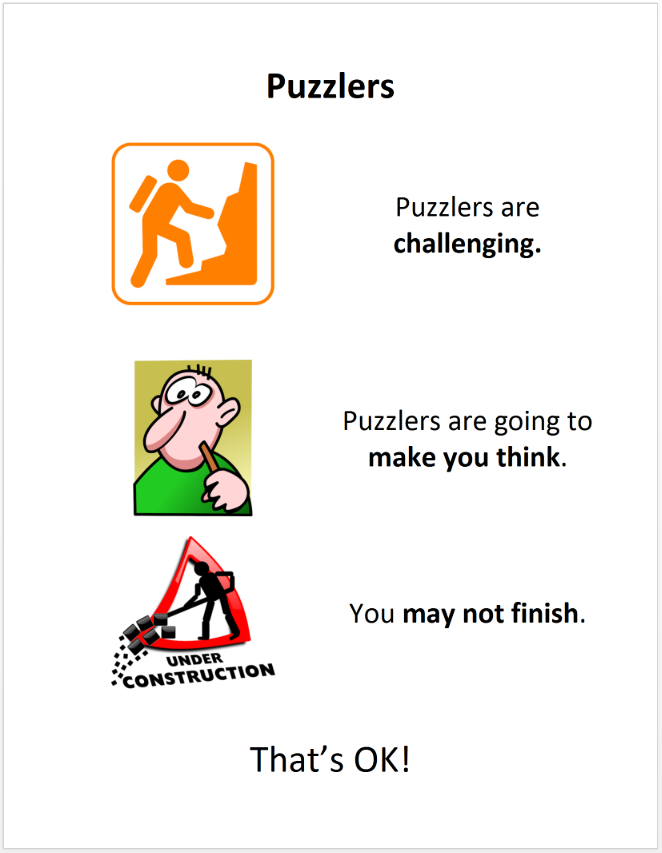
Let's return to the idea of Puzzlers that we touched on in the beginning. I use the term puzzlers instead of the word "problems"or "problem solving" because of the emotional connections students have with the words "puzzlers" and "problems". I use Puzzlers in my class all the time. Every day.

Using “Puzzlers”
One way you can do this is to provide students with a question that is slightly above their skill set. For example, you are working on 2 digit addition. You start with a simple question such as 21 + 33. This is a question without regrouping. You notice that students have mastered this so you tell them you are giving them a “Puzzler”. A “Puzzler” is a bit more challenging. A “Puzzler” is going to make you think. And, you may not finish the “Puzzler” in the amount of time you are given and that’s ok as long as you persevere for the entire time you are given. You give students the new question 28 + 33. This question has regrouping. Students are provided time to work in a Think-Pair-Share process where they work on their own (typically no more than 2 minutes so that frustration doesn't have time to set in), share their strategy with a partner and then some students share with the class. You can talk about how they solved it. How is it similar to what they've done? What makes it a puzzler? Then give them an opportunity to practice by providing another question that involves simple regrouping. This allows the students who didn't figure it out an opportunity to try the strategies that they heard. When students are comfortable, you can give them a new puzzler such as 48 + 95 or 138 + 26. You decide what the next more complex question would be.  By using this processes, I only have to "teach" the first easy step. After that, they learn to puzzle their way through it.

I love this method because it teaches students that they can figure things out on their own. They build perseverance. They learn that it's ok to struggle in the beginning and to just keep plugging away at it. They learn that sometimes they may have to get outside help to understand and that's ok. Students can also work at their own rate on these. Often I will have several puzzlers written out on the board in different colors. They will try the first one, self assess and tell me if they are ready to move up in complexity or if they would like me to give them another of the same color type to try again. I've never had a student keep working on the same color if they should be moving up to the next color. They want to try a harder puzzler. They want to get up to the super duper ooper puzzler (that is always above grade level). When a student is confidently working above grade level, I just get them to create their own puzzlers. They solve it and trade with other students who are working at that level as well. This gives me time to support all of the students who need more help.

I created this simple poster to put up in my classroom. Download it and feel free to use it as is or edit it.

Problem Solving is NOT a unit of study...
Problem Solving is not a unit of study you do in June. It has to be embedded every day all year. You don't develop problem solving skills by limiting problem solving time to solving a word problem of the week or as a unit at the end of the year or even by doing a project at the end of each unit. It has to be developed EVERY SINGLE DAY ALL YEAR.

Problem Solving does not have to be a word problem...
Is this problem solving? 25 x 14
It depends. Did you already teach your students how to multiply two 2 digit numbers? If so, then it is not problem solving. It's practice. OR, have they just learned the distributive property as it relates to 2 digit by 1 digit multipliction? Then, yes it is problem solving because they are taking that understanding and applying it to a new context. Keep in mind, though, you may have students who knew how to do this before they came to you so for those students, it is practice.

Is this problem solving? 2 x 6
It depends. Have you already been working on these facts? If so, it is not problem solving. Even if they don't know the answer, they still have learned the skills to figure it out.  OR, have you learned only up to 2x5 and students have to figure out how to use the facts they do know in order to figure it out. In this case, it's problem solving.

Where do I get the ideas for puzzlers?
The same place you get all your questions...your brain, the internet, textbooks, etc. Just stop pre-teaching everything. Help them understand the lowest level (21 + 7) and then give the rest as puzzlers. Start with the word problem that you would have given them at the end of learning.

Another simple method I've used...
When I taught high school math, I used to teach the steps for everything. Do this first. Do this next. Rinse and repeat. One day, in the middle of a lesson, I looked at the next question and thought to my self - this question is similar to what we have been doing but a little bit different - so I tried something new.  This is how the activity progressed:
T: Ok class. We are going to try something different. Put your pencils down. Don't touch them. Now, I'm going to give you a minute to read the next question and think about what you might try first to solve this. Don't do anything though. Don't touch your pencil. Just think about it. Don't worry about doing the question. I'm not looking for an answer...just a possible first step to try.
I gave students a minute or two to think.
T: Turn to your partner, tell them what idea you had for a first step and why you think that would be a good first step. It's ok if you're not confident that it will work or that it's right. Just share.
Partners share ideas. 
T: Who would like to share either their first step or their partner's first step?
Students share different first steps.
T: You've heard several possibilities for a first step. Let's decide on one to try first.
I had them vote. If I am worried that they are leaning towards one that won't work and this is the first time they are playing in a problem solving context, I will choose for them.
T: We are all going to do this first step together. Walk me through it.
I wrote on the board as students helped walk me through it. Many students also wrote it down but I'm a big fan of focusing on the process rather than copying when we are learning.
T: Now that we have the first step, take a moment to think individually about what our next step could be.
Repeat the Think Pair Share process until the problem is complete.

I loved this process because it taught my students what they needed to do in order to solve a question that appeared overwhelming in the beginning. Focus on the first step. Try it. Now what? Try it. Now what? Keep going.

After students were comfortable with this, I would make sure that we tried a recommendation that would not lead to a successful solution. This way, they learned how to deal with that situation. Oops. That didn't work. What did we learn from that path? Ok. Let's go back and try something different.

The biggest change I noticed? When students were given a question to try on their own, I stopped seeing hands going up immediately followed by "Mrs. Berg. I don't know what to do! You didn't teach us how to do this!" They had built the confidence to just try...something....anything...and see where it led.

All students are problem solvers.
Our job is to help them become better problem solvers.

Self-reflection question for you: What strategies do you use to build a problem-solving environment in your classroom?